Hitler's Rise to Power
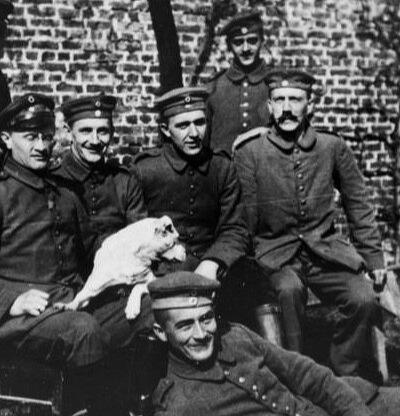
Hitler (seated on right) and fellow soldiers during World War I.
Hitler joined the German Workers' Party in 1919, which later evolved into the Nazi Party, and this was when his path to power began. He quickly rose to the position of leader thanks to his persuasive oratory and use of propaganda. Hitler took advantage of instability during the Great Depression to build support across the country and finish second in the 1932 presidential election. Paul von Hindenburg, who prevailed in the election, appointed Hitler chancellor in January 1933 as a result of Hitler's many strategies. The Reichstag fire that followed the following month justified a decree that nullified all freedom protections. The Enabling Act was approved on March 23, giving Hitler total authority. He established himself as the Führer after Hindenburg's death on August 2, 1934, when the chancellorship and the presidency were merged.
ANALYSIS
We will now be analyzing Hitler's identity before and as he rose to power through various perspectives.




PSYCHOLOGY
Hitler’s actions have been given a variety of psychological explanations, including explanations in terms of the “poisonous pedagogy” of his father, the inadequate mothering he received in early childhood, his assuming the burden of his parents’ marital problems, his being from a culture which failed to support healthy identity formation, and his repressing anger over the failure of his mother’s Jewish doctor to save her life. These are just a few of the many efforts at psychological explanations of Hitler.Alan Bullock characterized Hitler as an opportunist whose ideology and sermonizing was nothing more than a propagandist’s cunning theatrics designed to accumulate power for himself and the Nazi Party. MacCurdy refers to an earlier report in which he had spotted three such “morbid tendencies”, classifying these as “Shamanism”, “Epilepsy” and “Paranoia”. “Epilepsy” referred to Hitler’s cold and ruthless streak, but also a tendency to lose heart when his ambitions failed. MacCurdy also said that Hitler has a “Messiah complex”, in which he believed he was leading a chosen people on a crusade against an Evil incarnate in the Jews. He felt that this was starting to become a dominant tendency in Hitler’s mind. The paper notes an extension of the “Jew phobia” and says that Hitler now saw them not just as a threat to Germany, but as a “universal diabolical agency”. There is no one psychological explanation that has yet satisfactorily explained Hitler’s hatred of Jews. Stone further suggests that Hitler's hatred for his father fueled his hatred of Jews, who, after his father died when Adolf was only fourteen, served as scapegoats for his residual fury. Hitler, like so many victims of physical or sexual abuse during childhood, may have experienced an extraordinary sense of helplessness and powerlessness as a boy, stemming mainly from his poor relationship with his exceedingly domineering and controlling father. It is frequently this feeling of total helplessness and powerlessness in childhood that drives what Nietzsche called the exceptional "will to power" later in life. Alfred Adler pointed out, that such tragic circumstances engender "inferiority feelings" which, in the form of "increased dependency and the intensified feeling of our littleness and weakness, lead to inhibition of aggression and thereby to the phenomenon of anxiety. There is no question that Hitler's personality included pathological narcissism or what Stephen Diamond called psychopathic narcissism and may have even met modern diagnostic criteria for narcissistic personality disorder. Moreover, Murray, who never actually met or examined Hitler in person, states that Hitler manifested other signs of neurosis toward the end of his four years of military service during W.W. l, when he developed a case of "hysterical blindness" and "mutism," possibly in response to "shell shock" or what we now call PTSD. Even earlier, Hitler is said during adolescence to have developed "syphilophobia," a dread of being contaminated by sexual contact with women, leading eventually to sexual impotence according to acquaintances.
SOCIOLOGY
Sociology recognizes that our relationships with other people play a vital role in our lives and identity. The self is said to be socially constructed in the sense that it is shaped through interaction with other people. This was also the case for the Nazi leader, Adolf Hitler.The first relationships most people form are with their family. In Hitler's case, he loved his mother but disliked and feared his father. Adolf’s mother, Klara, was sick and young Adolf would take care of her. Klara’s death from cancer hurt Adolf greatly. It was speculated that the reason why Hitler hated Jews was that his mother’s physician was a Jew. Implying that the Holocaust was Hitler's revenge on Dr. Bloch for his inability to save Klara’s life. In reality, Hitler did not hold Bloch responsible for his mother’s suffering. After her death, he actually wrote to Dr. Bloch thanking him for his devoted care. Three decades later, when Bloch wrote to the chancellor asking for help, Hitler arranged for him to be spared the harsh measures being taken against Jews until he could make arrangements to emigrate to the United States.Adolf’s father, Alois, was a customs officer. His parenting style is described to be authoritarian, controlling, and aggressive. Alois wanted his children to be successful and he did not hesitate to give Adolf a “sound thrashing” or a beating for the slightest transgression. Alois’ aggression would then descend on Adolf. Paula, Adolf’s sister, revealed that his brother was a bully as a teenager and also did not hesitate to beat her. The aggressiveness during Adolf’s childhood may also account for his aggressive behavior as a dictator.In Adolf’s book, Mein Kampf (English: My Struggles), he mentioned that during his youth, he mixed up with some of the roughest of the boys. This led him to be the “reverse of a stay-at-home.” He also mentioned that “an inborn talent for speaking” developed during arguments he used to have with his schoolmates. He stated that he became a ringleader in his school. It can be said that these arguments lead to his known skill of being an “effective public speaker,” as some would say.Hitler didn’t seem to have many friends from his youth. Perhaps the closest to him was August Kubizek. Kubizek published a book titled “The Young Hitler I Knew” about their friendship during their late teen years. Their mutual passion for music created a strong bond between them. Kubizek was a good audience for Hitler, who often rambled for hours about his hopes and dreams. Sometimes, Hitler even gave speeches complete with wild hand gestures. Kubizek would then describe Hitler as “violent and high strung.” Hitler could not stand to be corrected and would only tolerate approval.Romance is a normal part of life for most people. For young Hitler, he did not have any experience in this department. But he did have an obsessive interest in a young blond named Stephanie. He would write her love poems but he never gave them to her. He wasn’t even able to pluck up the courage to introduce himself to her. Hitler told his friend Kubizek that he was able to communicate with her by intuition and that she was aware of his thoughts and had great admiration for him. He was also jealous of any attention she showed to other young men.Eva Braun was one of the few who was able to have an intimate relationship with Hitler. They married each other 29th of April 1945, just a day before they died by suicide.With Hitler, we see how his relationship with his family, particularly his father, has shaped him and affected the way he interacts with other people when he got older. His father's authoritarian parenting style might have resulted to him mixing up with the 'rough boys,' being rebellious and mischievous, and having a hard time in building relationships with other people.
ANTHROPOLOGY
To a considerable extent, when Hitler’s party came to power in early 1933, socio-cultural anthropology (Völkerkunde) was institutionally separate from biological anthropology (Humanbiologie or Physische Anthropologie) at most museums and university institutes in Germany. This was also true for Austria after the “Anschluss” (“union,” or annexation) of March 1938. As a consequence of the Anschluss, Vienna became the second-largest academic site in the “Third Reich.” Its institutional landscape for Völkerkunde included (as of the late 1920s) a university institute, a museum, a missionary educational center (since 1906), subdivisions in Vienna’s Academy of Sciences (after 1914), and the Anthropological Society of Vienna (as of 1870). In terms of size and institutional diversity, case studies from Vienna can therefore be taken as good indicators of how socio-cultural anthropology was carried out under Hitler and in exile: who profited from its practices, stood by, and suffered and resisted. All of these questions need to be raised and explored, but many of them cannot yet be fully answered.Under Hitler, socio-cultural anthropology took on a radical agenda in both its practical and empirical dimensions: addressing the (print and radio) media was one important component, as was reaching out to the public through spectacular colonial and imperial museum exhibits and lectures. Case studies from Vienna can thus be taken as good indicators of how socio-cultural anthropology was carried out under Hitler and in exile: who profited from its practices, stood by, and suffered and resisted.
PHILOSOPHY
In The Philosophy Perspective, Many believed that Adolf Hitler was impulsive, egocentric, cold, aggressive, un-empathic, and tough-minded. Hitler viewed his life through the writings of Arthur Schopenhauer- a philosopher. There are Schopenhauer's Writings in which described hitler is a semi-literate, semi-sane outlier who somehow lucked his way to Power in Germany. On 30 January, 1933, German President Paul von Hindenberg appointed Adolf Hitler as Chancellor of a coalition government joining the political forces of the nationalist conservatives and National Socialists under Hitler’s leadership. Hitler said in his speech "On January 30, we took over the government. Devastating conditions have descended upon our Volk. It is our desire to remedy them, and we will succeed in doing so. Just as we have eliminated these adversaries despite all the scorn, we shall also eliminate the consequences of their rule". In 1933, The German Government changed from Democracy to Dictatorship from 1933 until his death in 1945. In the Hitler's Ethic Book by Richard Weikart. Weikart implies that Hitler was not driven by a hunger for power as He Conquered Countries. Rather, He believed that Hitler an ethic or principle which is the foundation for his actions before and after his time as the Fuhrer.